The Complete Water Damage Restoration Process in Duluth, GA
Most Duluth homeowners who call a water damage restoration company after a flood or pipe burst have no idea what the next 2–3 weeks will look like. The restoration process has multiple distinct phases, each with its own purpose, timeline, and decision points — and understanding what’s happening and why makes a significant difference in how you manage the experience. This guide walks through the complete water damage restoration process from the initial call through final reconstruction, with specific context for Duluth, GA and Gwinnett County.
Water Damage in Duluth? Call (877) 698-1311
Duluth Water Damage Restoration handles every phase from emergency extraction through reconstruction. Serving all of Gwinnett County.
Phase 1: Emergency Response and Assessment (Hours 0–4)
The restoration process begins the moment you call. For Duluth properties, we target on-site arrival within 1–2 hours for emergency situations — sooner for active flooding where extraction speed is most critical.
Initial assessment: Our first action is to identify the water source and confirm it has been or can be stopped. A supply line burst that is still actively releasing water requires stopping the flow before extraction begins. Sewage backup events require confirming the drain has been cleared or isolated before extraction equipment is placed.
Water category determination: The technician identifies whether the water is Category 1 (clean), Category 2 (gray), or Category 3 (black water), based on the source, appearance, and elapsed time since the event began. This classification determines the protocols, equipment, and materials handling for the entire job.
Scope assessment: Using moisture meters and thermal cameras, our team maps the full extent of water migration — documenting not just the visible wet areas but the hidden moisture in walls, under floors, and above ceilings that the eye can’t detect. This mapping determines the extraction scope and the drying equipment configuration.
Documentation: Photographs and moisture readings from the initial assessment form the foundation of your insurance claim documentation. Everything is timestamped and retained.
Phase 2: Water Extraction (Hours 2–8)
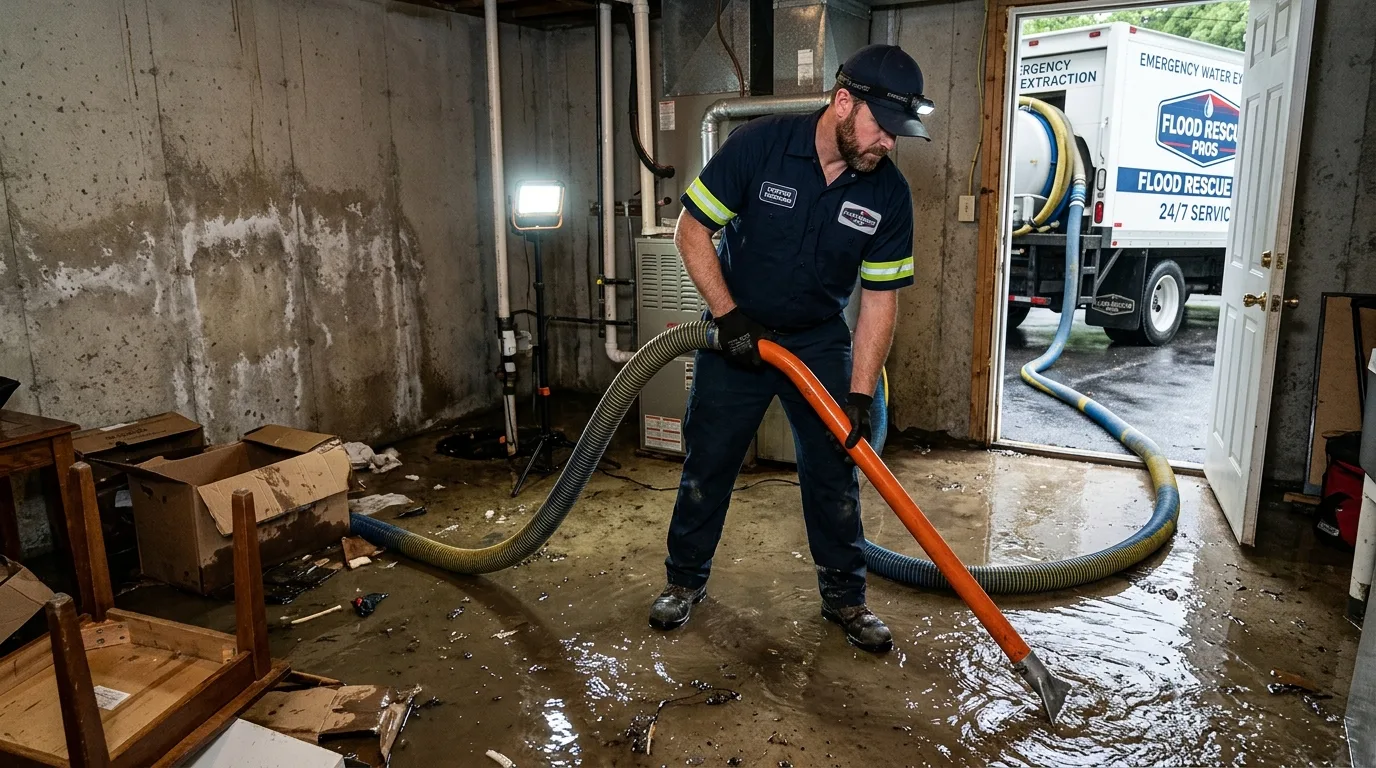
Extraction is the rapid removal of standing water using truck-mounted extraction units, submersible pumps for standing water in basements, and commercial wet-vacs for residual water in tight spaces. In a typical Duluth residential event, extraction of standing water takes 1–4 hours depending on volume.
Extraction removes bulk water but does not make materials dry. Water absorbed into carpet, subfloor, drywall, and insulation during the flooding event remains in the structure after extraction is complete. This is why structural drying equipment is deployed immediately after extraction — the drying phase is where the real work of preventing mold and material damage occurs.
Salvageable vs. non-salvageable materials: During extraction, the technician identifies which materials can be dried in place and which must be removed. Category 1 carpet with a short flood duration may be extractable and dryable. Category 2 or 3 carpet is removed immediately. Drywall with limited saturation in a Category 1 event may be drillable (drilling holes at the base of walls allows interior cavity drying). Heavily saturated drywall or any drywall in contact with Category 2 or 3 water is removed.
Phase 3: Structural Drying (Days 1–7)
Structural drying is the phase that Duluth homeowners sometimes underestimate — because the structure may look essentially dry after extraction, and the idea of having industrial equipment running for days can seem excessive. It isn’t. Here’s why it matters:
Gwinnett County’s summer climate (June–August) creates ambient relative humidity conditions where materials cannot naturally dry without mechanical dehumidification. Wood framing that looks and feels dry at the surface may contain 25–30% moisture content internally — well above the 19% threshold at which mold can grow in wood. Only calibrated moisture meters reveal this, and only commercial dehumidifiers can remove the moisture from the structure in the timeframe required to prevent mold.
Equipment: Commercial air movers (high-velocity axial fans positioned at floor level) evaporate moisture from structural surfaces. LGR or desiccant dehumidifiers capture that evaporated moisture from the air and discharge it as liquid. For a typical Duluth residential event, expect 4–8 air movers and 1–3 dehumidifiers running continuously for 3–7 days.
Monitoring: Our technicians visit the property daily to record moisture readings at the same monitoring points each day. These readings document the drying curve — the expected decline in moisture content from initial readings toward target values. If drying is proceeding slower than the psychrometric model predicts, equipment is adjusted (repositioned, additional units added, or heat introduced). Daily logs are included in the final documentation package for your insurer.
Duluth Water Damage — Full-Service Restoration from Day 1
We handle every phase from emergency call through final reconstruction. Call (877) 698-1311.
Phase 4: Material Removal (Days 1–5, Overlapping With Drying)
Material removal happens in parallel with drying, not after it. Materials that are identified for removal — wet drywall, saturated insulation, Category 2 or 3 carpet — are removed promptly to expose the structural assembly (framing, subfloor, concrete) to the drying airflow. Attempting to dry saturated wall assemblies without removing drywall is ineffective; the interior cavity retains moisture that the air movers can’t reach.
Controlled demolition in Duluth restoration projects is performed to the minimum necessary scope — removing enough material to expose wet structural elements to drying airflow without destroying sound building elements unnecessarily. This approach, called “flood cuts” (horizontal cuts in drywall at the upper boundary of moisture intrusion), preserves as much original material as possible while ensuring complete structural drying.
All removed materials are inventoried, photographed, and staged for disposal. This inventory feeds your insurance claim’s scope of loss for replacement cost valuation.
Phase 5: Drying Verification and Equipment Removal (Day 5–7)
When daily moisture readings indicate that all structural materials have reached their target moisture content — typically 8–12% for wood, dry for concrete, with ambient relative humidity below 55% — the drying phase is complete. A final documentation package including all moisture readings, equipment records, drying curves, and material removal inventory is compiled.
Our technician conducts a final walkthrough confirming all areas are at target moisture content, all equipment is functioning within specifications, and no concealed wet areas remain. Equipment is then removed and the space is ready for the reconstruction phase.
Phase 6: Antimicrobial Treatment (If Required)
For Category 2 or 3 water events, antimicrobial treatment is applied to structural surfaces after drying verification and before reconstruction. This treatment — using EPA-registered biocides applied by our Georgia Department of Agriculture-licensed technicians — prevents mold colonization in the structural assembly during the reconstruction period. Treatment is documented with product names, concentrations, and application areas for the insurance record.
Phase 7: Reconstruction (Weeks 2–4 and Beyond)
Reconstruction replaces damaged materials with new: new drywall, new insulation, new flooring, new cabinetry if affected. The scope is determined by the material removal inventory. In Duluth, reconstruction bid pricing is submitted to your insurance carrier before work begins, and carrier approval is obtained (or the scope is negotiated) before materials are ordered.
Reconstruction timelines for typical Duluth residential events run 1–3 weeks for contained events and 4–8 weeks for larger-scope projects involving multiple rooms or structural repairs. All reconstruction work is performed under required Gwinnett County building permits with inspection coordination managed by our team.
Frequently Asked Questions
How long does the complete water damage restoration process take in Duluth?
For a typical residential event in Duluth — a burst pipe affecting 1–2 rooms — expect the extraction and drying phase to take 5–7 days, followed by 1–2 weeks of reconstruction. Total time from call to move-back-in is typically 2–4 weeks. Larger events involving multiple floors, structural damage, or Category 3 water can extend to 6–10 weeks or longer depending on reconstruction scope.
Can I stay in my Duluth home during water damage restoration?
In many cases, yes — if the damage is limited to specific areas and the rest of the home is habitable. Running restoration equipment (air movers and dehumidifiers) increases noise and indoor temperature, and Category 2 or 3 events may require occupants to vacate affected areas. Category 3 events with significant sewage contamination may require vacating the home until post-remediation clearance testing confirms safe conditions. Your restoration contractor advises on habitability at the initial assessment.
What is a “flood cut” and why is it done to my walls?
A flood cut is a horizontal cut in drywall at approximately 1–2 feet above the flood line, removing the saturated lower portion of the wall while leaving the upper portion intact. This technique exposes the interior wall cavity — the stud space, insulation, and bottom plate — to the air movers’ airflow, allowing the structural assembly to dry completely without removing the entire wall. Flood cuts are the standard technique for restoring drywall in water damage events and result in less total drywall replacement than removing entire wall panels.
Related: